ADVERTISEMENT - LegalConsumer.com does not endorse or review advertised products or services.
Bankruptcy Means Test Calculator
Means Test CalculatorThis is a public beta. "Public beta" means that, to my knowledge, this calculator is working correctly. When I am made aware of errors I fix them. As of this version, there are no errors I know of.
That said, I've developed enough software over the years to know that there are always cases that turn up that were not encountered in testing. Also, this revision features several under the hood rewrites to make the code more efficient and easier to maintain.
So, as always, please, if you encounter an error, let me know (click here) and I will investigate, and fix it. Thanks! Other users will thank you.
Use the calculator as you see fit. You can click the links to original sources to confirm that they are correct and up to date. You can also check its math. As far as I know, it's correct. Chances are, this will always be a beta because it is being constantly updated, tweaked, enhanced, etc.
I hope you find it useful as you decide how to deal with your financial affairs.
Albin J. Renauer, creator and developer of the Means Test Calculator ©2005-2013
RelationalVision, LLC / Berkeley, CA
www.legalconsumer.com
Based on numbers published by the U.S. Trustee's office for Cases Filed On and After May 1, 2013.) You are user # 0 of the Means Test Calculator.
Despite what you may have heard about recent changes in bankruptcy law, most people who need bankruptcy protection are still eligible.
Are you?
This calculator will help you find out.
Calculator Navigation
It applies the formulas, regional income and expense standards, and calculations of the new "means test" that was a cornerstone of BAPCPA, the bankruptcy law (11 U.S.C. 707(b)). It uses the language and formatting of Official Form 22A -- one of several forms you would need to complete if you decide to file for bankruptcy.
Read the instructions carefully. If you are unsure whether an item applies to your situation, make a note of your question. Ask a bankruptcy lawyer about it if you go for a free consultation.
If your monthly household income is less than the Nevada median income for a household of your size, you are presumed to be eligible to file for Chapter 7 bankruptcy under Section 707(b)(2).
What
is the means test? You may have read that the new bankruptcy law imposes a "means test" on who can file for Chapter 7 bankruptcy.
You might think this new test will prevent you from filing. But, chances are, you're wrong. Most people considering bankruptcy have no trouble passing the means test. Indeed, some lawyers think more people will qualify for Chapter 7 under this test than under the old law, where judges had no fixed formula.
Use this calculator find out where you stand.
The Formula
The law now uses a standard mathematical formula to determine whether you can file for Chapter 7 -- or, to put it in legal terms, whether filing for Chapter 7 would be an 'abuse' of the bankruptcy system. (Those who fail the means test, are left with a Chapter 13 repayment plan as their only bankruptcy option.)
The means test is actually a two-part test and you only need to pass one of them to qualify for Chapter 7.
Test 1. "Median Income"
This is a very simple test that compares your average household
income for the past six calendar months to the median income for your
state, If your income is below the median, you qualify for Chapter 7.
If it is above the median, you must pass Test 2.
Test 2. "Disposable Income"
This test deducts expenses from your income to determine how much you
can pay your unsecured creditors over the next five years:
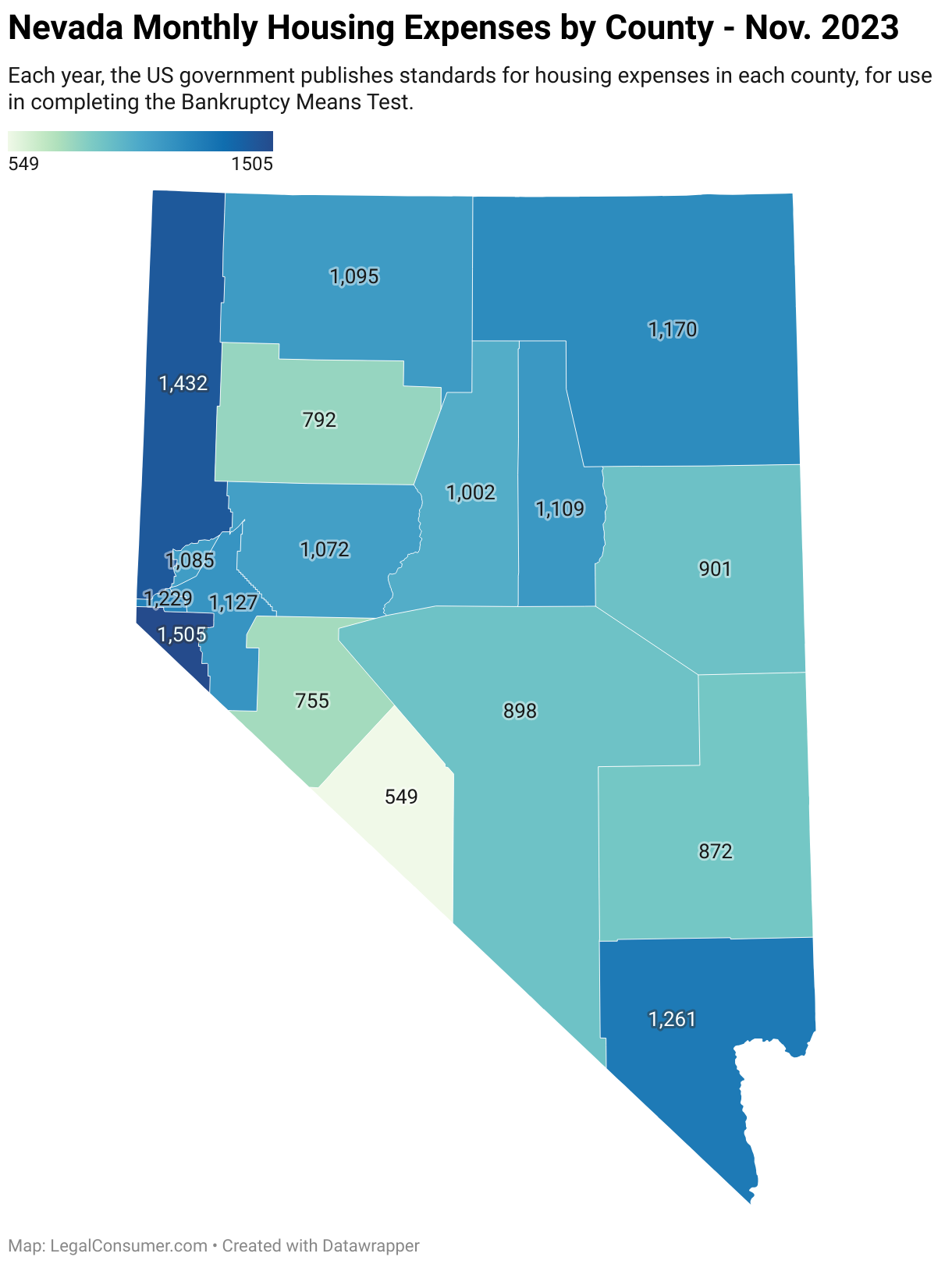
Certain deductions are standard allowances based on the number of vehicles you operate, the number of people in your household, and the cost of living in Clark County.
In addition, to these standard deductions, you can also deduct the full amount of certain actual expenses such as mortgage and vehicle loan payments.

Do
I need to complete the means test? If you are filing for Chapter 13 bankruptcy, you do not need to complete the means test. However, you do need to complete a form almost identical to it — and that will determine how much you must pay in a Chapter 13 plan.
If you want to file for Chapter 7 bankruptcy, you must at least complete the first part of the form to figure your "current monthly income" (CMI), which is based on your average income over the past six calendar months. That number will determine whether you must complete the rest of the form.
If your CMI is below the median income for Nevada for a household your size, then you do not need to complete the means test.
If your CMI is higher than the median for Nevada for a household your size, you must complete the means test to compute your monthly "disposable" income (that is, income minus expenses). The result of that computation will determine whether you are eligible for Chapter 7 bankruptcy.
How
long does this take? Using this calculator takes about 20 minutes. For some, the answer may be obvious after only a few questions.
This calculator is completely anonymous. We do not ask -- and no not want -- any personally identifying information linking you to these numbers, other than a zip code. We do keep statistical data on amounts that user have entered, so that the site may monitor the needs of its users and adjust services accordingly. However, To us, this is data for statistical analysis only. For more information. See the privacy notice.
If you don't put in the correct numbers in the correct blanks, this calculator won't give you an accurate result. It only does the math. It is your responsibility to put the right numbers in the right blanks. Helpful resources are available throughout the test to help you figure out what the form is asking for and what to put where.
Be sure to account for all the different kinds of income you receive. If you're not sure what to put in an 'expense' blank, skip it. You may find that it doesn't' matter -- that is, you may qualify regardless of what number you put in that blank.
If you need assistance, this website has listing of books and local services that offer bankruptcy help.
If you end up actually filing for Chapter 7 bankruptcy you need to fill
out official
form (22A). which you can find here.
This calculator is based on that form.
Household
Size: When is a family of 3 not a family of 3?The issue of household size can be tricky in cases of shared custody, children who live at college part of the year, or non-custodial children living in the household.
There will undoubtedly be litigation on this subject. The official form seems to suggest that the issue is whether the person is part of the household and is a dependent. (That is, you can't include a roommate who is not your dependent in your household size, yet you may have to include the portion of their income that contributes to the overall income of the household. See the help topic on that subject. This can be an issue for same-sex couples who cannot legally marry.)
RELATED INFO:
In April 2010, the United States Trustee's office issued a PDF of their official position on legal issues surrounding each line of the Chapter 7 means test form 22A. Keep in mind that the Trustee tends to protect creditor interests, so a debtor's bankruptcy attorney may not agree with every one of these positions. That said, if you can easily pass the means test under the trustee's relatively stingy interpretation of the rules, all the better.
The U.S. Trustee's Office's official statement (released April 2010) on how to fill out form 22A
takes the the following position on how to fill out the means test:
Line 14, Applicable median family income.
Line 8 of the means test:

Contributions
of roommates or domestic partners to household incomeAt least one site on the web has addressed this issue. King's Bankruptcy Media (a lawyer's website) states what appears to be the correct rule: that, if a roommate or domestic partner is contributing income to the household, then that portion of the roommate's income must be included in the overall amount of 'household income' on line 8 of the official form, where it asks for "contributions to household income."
RELATED INFO:
The U.S. Trustee's Office's official statement (released April 2010) on how to fill out form 22A![]()
takes the the following position on how to fill out the means test:
Line 14, Applicable median family income.
Line 8, Any amounts paid by another person or entity, on a regular basis, for the household expenses of the debtor or the debtor's dependents, including child or spousal support.

Other
Noteworthy Calculators on the WebCNN/Money Magazine's Budget Calculator compares your monthly expenses to national averages for people with your income and home situation. It's not localized by location.
The bankruptcy court for the Middle District of Florida provides an Excel worksheet of a means test calculator, but it only has figures for counties in that Florida district, and the numbers have not been updated since 2007.
ChooseToSave.org offers an extensive list of calculators for all types of financial decisions including car loans, credit cards, college savings, to retirement savings options.

If
I Pass the Means Test, Can I still be barred from filing bankruptcy? Yes, you can still be barred from filing Chapter 7 bankruptcy.
Passing the means test removes one barrier: it means that you are not "presumed" to be "abusing" the bankruptcy system under 707(b)(2). It is an essential first step, and for most people, that is that. They are clear to file.
However, in some cases, a bankruptcy judge may rule that case should be dismissed becuase to the "totality of the circumstances" under 707(b)(3).
Example 1: In Iowa, a judge ruled that a debtor was abusing the system because in the year preceding his bankruptcy, he received substantial sums of money from various sources and spent it all on unnecessary indulgences, rather than pay down his debt. In re James, 345 B.R. 664 (Bkrtcy.N.D.Iowa 2006).
And, while the means test income analysis looks backward, a court can use 707(b)(3) to look forward.
Example 2: In another example, a Northern California court denied a debtor the right to file Chapter 7 because the debtor was about to have a substantial increase in income. In re Pak, 343 B.R. 239 (Bkrtcy.N.D.Cal. 2006).

If
I fail the Means Test, can a judge allow me to
file anyway? Yes, a judge can allow you to file for Chapter 7 bankruptcy even if you fail the means test, but only you are able able to show "special circumstances."
Some examples of possible "special circumstances" are job loss or pay cut, a serious medical condition, or unusually high child care expenses. You must be able to produce proof of your expenses and that your expenses are reasonable -- and that you have no reasonable alternative.

What
are "priority claims"? This is a technical term used in bankruptcy law. A list of the most common priority claims can be found on Form 10 (Proof of Claim). These include
The full list of the nine types of
priority debt is found in section 507(a) of the bankruptcy code. 
ADVERTISEMENTS - Services listed in advertisements are not endorsed or reviewed by LegalConsumer.com
Household Size: 1
Vehicles:
- on which you pay operating expenses: 1 (Line 22)
- on which you pay ownership or lease expenses: 1 (Line 23)
County: Clark
Metro Area: West Region
Nevada Median Income for a 1 person household: $3,744 per month
Your monthly income for means test : $0 (See Part 2 and Part 4 Line 18)
for 1 person in Clark County, NV.
$445 monthly expense allowance for housing and utilities, non-mortgage expenses (Line 20A)
and
$1,285 monthly expense allowance
for mortgage/rent expenses (Line 20B)
(This is a minimum amount. if your
mortgage payment is higher, you get the full amount of the mortgage.Not
so for rent, unfortunately.)
$583 monthly allowance
for food, clothing, household supplies, personal care, miscellaneous (Source:
National Standards (for 1-person households, regardless of income.)
$0 monthly allowance for 'out-of-pocket healthcare costs' other than health insurance
(Source:
National Standards for
* persons under 65
@$60/person and
* persons 65 or over
@$144/person.
See line 19B)
$ monthly allowance for mass transit or vehicle operation expenses (i.e. gas, repairs, maintenance) for vehicle s in West Region
$ 0 additional monthly allowance claimed for public transportation (Line 22B)
$ 0 monthly allowance for vehicle ownership or lease expenses for vehicle s . (This is the standard amount. If your car loan payment is higher, you can deduct the full amount of the car loan. Not so for lease expenses, unfortunately.)
Household size:
Location: Clark County, Nevada (West Region)
Vehicles:
- that you pay expenses on:
- that you own or lease:
NV monthly median for a -person household: $3,744
Your monthly household income $0 (line
12)
Income is below state median.
You qualify for Chapter 7
(no need to compute expense deductions).
Monthly income for means test: $0 (line 18)
Automatic
Deductions for Clark County: $2,313
Other Deductions (for Actual Expenses): $0
Deductions for Debt Payment
$0
TOTAL DEDUCTIONS: $
2,313
$
-2,313 per month
($-138,780 over 5 years)
Based on the information you have entered so far, you pass the means test requirements to qualify for Chapter 7 bankruptcy, because your monthly income of $0 is below the median income for -person households in Nevada ($3,744).
Summary of your data:
Your average monthly income is $0 and, so far, you have expense deductions totaling $ 2,313 per month. That would leave you with $ -2,313 at the end of each month to pay into a hypothetical, five-year Chapter 13 bankruptcy plan, which would pay your unsecured creditors $ -138,780 over the next five years.

LegalConsumer.com helps you find local Nevada information and services
to help you file for bankruptcy.
If you don't own the book, you can still use this site and the free Clark County means test calculator.
Don't own a copy?
Learn more...
| "Exceptionally clear."
The New York Times |
| "How to File for Chapter 7 Bankruptcy advises on everything from how to file court papers to how to respond to threats from creditors.... A do-it-yourself bankruptcy book for people who can’t afford expensive lawyers."
Newsweek |
| "An in-depth guide to filing under Chapter 7, including state-by-state and federal exemptions as well as forms for do-it-yourself filers."
Kiplinger’s Personal Finance Magazine |
| "Can help you decide if bankruptcy is the right option for you." Detroit News |
| "A valuable, easy-to-understand workbook."
Los Angeles Times |
| "Includes clear instructions on when and how to fill out all the necessary forms, which assets you may legally keep, even advice on whether your case is complicated enough to make it worth your while to hire a lawyer."
Forbes |
| "The best [bankruptcy books] I know are published by Nolo."
Harry S. Gross, host of
“Speaking of Your Money” |
| "Covers all the recent changes to the bankruptcy law, and shows you how to get through the entire process with the least damage."
Accounting Today |
| "I bit the bullet, and purchased Nolo's How to File Chapter 7 Bankruptcy. I represented myself in court and I was granted a discharge of all debts five months later."
Danielle A.,
Richmond, VA |
Buy & Download now: Nolo (publisher)
ADVERTISEMENTS - Services listed in advertisements are not endorsed or reviewed by LegalConsumer.com
Total Bankruptcy can connect you with a bankruptcy attorney near you. Fill out the evaluation form or call (877) 257-9043.
![]()
Are you behind on your mortgage, taxes or other bills? Are creditors threatening foreclosure or repossession? Consider Chapter 13 bankruptcy, which can give you an affordable repayment plan -- and let you keep your house, car and other property. Use this plain-English guide to decide whether or not it's right for you.
Nolo's Chapter 13 Bankruptcy breaks down the Chapter 13 process and provides clear explanations of the law. First, you can:
Then, delve deeper into Chapter 13 and find out:
If you think Chapter 13 bankruptcy could work for you, you'll be ready to:
This newest edition includes information on hiring and working with a lawyer, recent court rulings that interpret the federal bankruptcy laws. You'll also find the latest bankruptcy exemption laws in your state, which determine what copy you can keep, and recent IRS standard expense amounts, which affect Chapter 13 plan payments.
In Paperback and eBook (Adobe Reader)
Pub. Date: May 2012
Edition: 11th
Pages: 496 pp
ISBN: 9781413310696
Forms: 29 forms
List Price: 39.99
Buy now: Nolo
(publisher)
| "In Nolo’s usual thorough fashion, here is a guide to an alternative to the typical Chapter 7 Bankruptcy."
Orange County Register |
| "An excellent book that can guide you through the [Chapter 13] process."
Forbes Magazine |
| "Chapter 13 Bankruptcy will save you a fortune in attorney fees and confusion."
The Midwest Book Review |
| "This is the best book going if you choose to file alone or if you want background on the Chapter 13 process."
Attorney Gary Klein,
co-author of Consumer Bankruptcy Law and Practice |
| "An excellent resource..."
Consumers Digest |
| "Contains many tear-out forms, federal and state exemptions charts, and the most recent legal documents and instructions on how to fill them out. "
Reference & Research Book News |
Buy now: Nolo (publisher)
by
Attorney Stephen
Elias.
In Paperback and eBook (Adobe Reader)
Pub. Date: May 2011
Edition: 4th
Pages: 419 pp
ISBN: 9781413313918
Forms: 27 forms
Buy this Book: Nolo (publisher's site)

An astounding 80 percent of credit reports contain errors. And if your credit report is one of them, it can have serious consequences: a bad credit score can make you ineligible for a good rate on a credit card or loan, keep you from renting a place to live, and even sabotage your chances of getting hired for a new job.
That's why you need to be certain that your credit record is accurate and up to date. Credit Repair shows you how to fix mistakes in your credit report -- and limit the damage caused by blemishes on your credit history.
In sharp contrast to "fix bad credit" scams, Credit Repair shows how you can effectively rebuild your credit record, step by step. Learn how to:
In Paperback and eBook (Adobe Reader)
Pub. Date: May 2011
Edition: 10th
Pages: 268 pp
ISBN: 9781413314205
Forms: 39 forms
Buy & download now @
Nolo
(publisher)
Press Reviews
|

If you're having trouble making your mortgage payments or are already in jeopardy of foreclosure, The Foreclosure Survival Guide compassionately gives you the practical information you need, step by step.
An essential tool for anyone at risk of foreclosure, The Foreclosure Survival Guide provides key information about:
The Foreclosure Survival Guide gathers all the information Attorney Stephen R. Elias has used to help hundreds of clients over 30 years of practicing law and shows you how to deal with foreclosure.
Like many hardworking people facing foreclosure in this rough economy, you deserve answers to your pressing questions. Thorough and easy to understand, The Foreclosure Survival Guide can help you stay in your home or walk away with money in your pocket.
Feeling overwhelmed by your debts? If you're ready to regain your financial freedom, feeling the squeeze of the housing bust or simply get smarter about managing your money, you'll find everything you need in this complete guide. Solve Your Money Troubles shows you how to:
To make the process easier, the 12th edition of Solve Your Money Troubles includes all-new sample letters to creditors which reflect changing financial times, as well as worksheets and charts to calculate your debts and expenses and help you create a repayment plan. You'll also get fully updated state laws and new information on dealing with foreclosure.
In Paperback and eBook (Adobe Reader)
Pub. Date: April 2011
Edition: 13th
Pages: 536 pp
ISBN: 9781413314212
Forms: 7 forms
Buy & download now @
Nolo
(publisher)

ADVERTISEMENTS - Services listed in advertisements are not endorsed or reviewed by LegalConsumer.com
Website and calculator content by Albin Renauer, co-author of How to File For Chapter 7 Bankruptcy (Nolo 2011)
LegalConsumer.com website & means test calculator ©2005 - 2013 RelationalVision, LLC. All rights reserved.
Users of this site agree to the Terms of Service and Privacy Notice.
